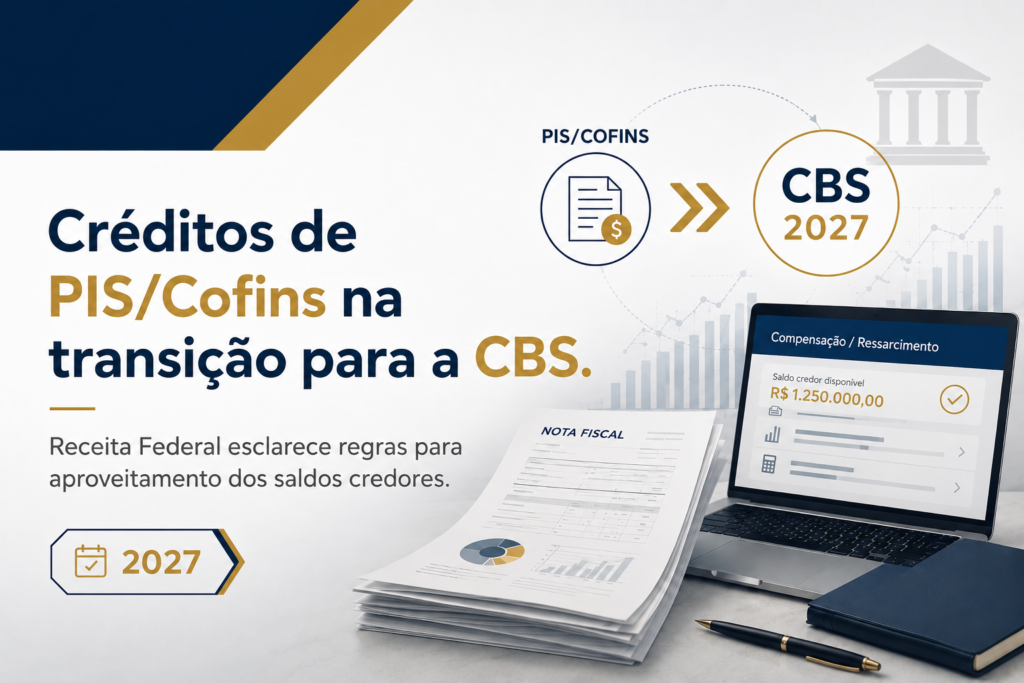


Brazil’s Federal Revenue Service published important clarifications on the use of accumulated PIS/Pasep and Cofins credit balances during the transition to CBS — the Contribution on Goods and Services set to take effect in January 2027, under Complementary Law No. 214/2025.
Many companies have a legitimate question: what happens to credits accumulated over the years? The Federal Revenue Service’s answer is straightforward — they will not be lost.
What CBS Is and Why It Matters
CBS is the new contribution that will replace PIS/Pasep and Cofins under the new Brazilian tax model. The transition is part of a broad reform, and concern over the credit balances accumulated by companies was among the main practical issues raised by the market.
With the publication of the clarifications, it was established that existing credits remain valid after the current contributions are extinguished and can be used in three ways: to offset CBS debts, for cash reimbursement, or to offset other federal taxes administered by the Federal Revenue Service. The rule applies both to credits already recognized and to those still to be accrued up to the transition date.
The Numbers Behind the Transition
The scale of the impact is significant. The Federal Revenue Service estimates that around 100,000 companies have outstanding PIS/Cofins credit balances, totaling approximately R$140 billion. Most of these companies — around 70% — have a balance below R$100,000.
In addition, approximately 12,000 companies were identified with discrepancies in their records, involving around R$44 billion in credits. These companies will be guided directly by the Federal Revenue Service to regularize their situation via EFD-Contribuições.
How the Credits Will Be Used in Practice
The process will be carried out exclusively through PER/DCOMP Web, the Federal Revenue Service’s offset and reimbursement portal, which will feature a specific function for the PIS/Cofins-to-CBS transition. The system will automatically retrieve the balances recorded in the December 2026 EFD-Contribuições filing — reducing rework and increasing the reliability of the information.
That is why the December 2026 EFD-Contribuições filing is a critical point: the amounts recorded there will be the basis for all subsequent use of credits. Companies with inconsistencies in this filing may face difficulties when using their credits.
What Your Company Should Do Now
Even though the transition is still set for 2027, now is the time to act. We recommend focusing on three areas:
First, check whether your company has a credit balance and determine the best way to use it — offsetting against CBS, cash reimbursement, or offsetting against other federal taxes.
Second, review your EFD-Contribuições filings to ensure the records are consistent and free of discrepancies before December 2026. Companies contacted by the Federal Revenue Service about irregularities will have time to regularize their situation, but it is far safer to act preventively.
Third, structure the PER/DCOMP Web request process in advance, so your team is ready to use the specific function as soon as it becomes available.
Aurius Corporate Can Help
Aurius Corporate’s Tax Consulting team is ready to support your company on all these fronts — from assessing your eligibility and reviewing your EFD-Contribuições filings to providing full advisory support throughout the offset and reimbursement process via PER/DCOMP Web.
Get in touch: comercial@auriuscorporate.com | (11) 99466-0621 | (11) 5080-0880